

More posts

.jpg)
%20(1).jpg)



How Optimal pivoted from EV-only to multi-fuel platforms while engineering across three continents
Manufacturing Today magazine speaks with Executive Vice President, Jeff Hiatt, about the creation of Optimal...
When political winds shifted on EV mandates, Michigan-based company Optimal made a pragmatic pivot by launching a gasoline-powered version of its low-floor shuttle bus – a move reflecting decades of OEM-level engineering prowess and five years of EV-specific development experience. After completing a PhD at the University of Michigan, Dr Song Young founded the computer-aided engineering (CAE) company with the aim of developing and utilizing technology that optimizes the engineering process, the products and the manufacturing of each project.
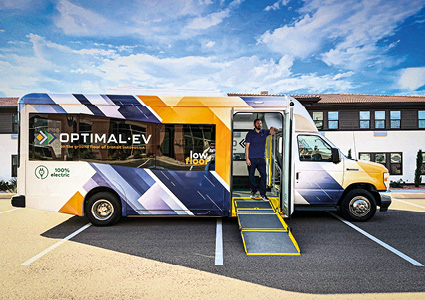
Manufacturing Today magazine speaks with Executive Vice President, Jeff Hiatt, about the creation of Optimal, the coordination of product development globally, and why the company is the only low-floor electric shuttle manufacturer in North America. “When Dr. Young launched the company, it began working with a lot of the local OEMs in and around the Detroit area, helping them with crash simulation and lightweighting projects up until about 2016,” Jeff tells us. “He then upgraded from solely delivering engineering services to being an OEM, and that’s when Optimal EV was formed. We’ve got a long history of engineering excellence in the Detroit area, which is a differentiator for us versus many of the other shuttle bus or specialty vehicle manufacturers.”
The gas-powered low-floor shuttle represents a strategic shift driven by political reality. “With the current administration change and focus shifting from EV-centric into more alternative fuel-centric, we’ve developed a low-floor gas product with the same body and chassis, but basically just a gasoline version,” Jeff explains. “During the previous administrations, there was a heavy focus on EV vehicle deployment, but this has now shifted towards a holistic approach for alternative fuel transportation, whether it be hydrogen, gas or CNG. We never intended to get into those markets but as we saw what was unfolding, we realized we needed to pivot for Optimal to survive and grow.” The gas product serves a practical purpose and is described by Jeff as a ‘bridge product’ that allows customers who are still undecided about EVs to experience the low-floor element while they evaluate.
Regional focus
With a distributed workforce spanning Michigan, Taiwan and Bosnia, each region has a specific focus. Optimal’s group in Bosnia carries out most CAD work and meshing, while the Michigan site focuses on design work, and the Taiwan team focuses on emerging technology. This geographic distribution creates a significant advantage in that the company can engineer around the clock, giving it a far more rapid development cycle. The Taiwan team has recently created another innovative product launch – a 360-degree camera system designed to advance vehicle safety.
“Technology seems to be further ahead in overseas markets,” Jeff continues. “We’re able to learn early on about new technologies and explore any advantages to deploying them here in the US. The 360-degree camera is one of the early AI-based camera systems on the market. It involves the installation of four cameras to monitor what’s going on around the bus and it uses the input from all the cameras to decide whether it needs to alert the operator to the potential hazard, which could be a person, an animal or another vehicle. As opposed to historical camera systems that use a single camera and flash one image, this uses all four inputs. We’re focused on a holistic safety system to help the driver out with their environment.”
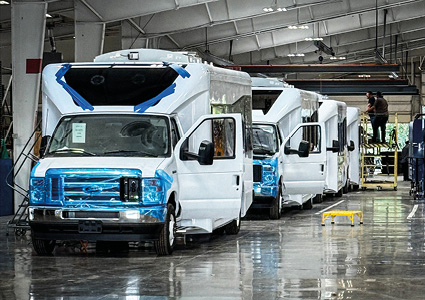
Surpassing 500,000 electric miles also provides the group with market credibility. “One of the huge benefits to the Optimal platform is that we use the same system in all our products, no matter which product we bring to market,” Jeff shares. “Miles are miles for us. We receive a tremendous volume of feedback and because it’s all on the same system, it builds a huge amount of credibility. A lot of companies come and go in this space, so being able to establish viability is critical, and calculating how many miles you surpass or how many units you have in the field is one of the key measures.”
With validation of product and building its brand at the forefront of Optimal’s priorities over the past two years, 2026 is all about growth, Jeff reveals: “Returning to gas from EV is very straightforward. We feel as though 2026 is our year to really grow the company, reach sustained profitability and drive the business forward. Looking three to five years ahead involves recapitalization and growing the business even further, whether it’s raising an initial public offering or finding another mechanism through private equity to get ready for that next level of growth, with some future products we’re considering bringing to market.”
Despite the challenges of a new administration, Optimal’s response to political shifts has only strengthened the company’s position. “The market is still strong, we’re still seeing demand and we’ll see increased demand with the gas product which will give us exponential growth,” Jeff concludes. “We firmly believe we’re positioned well for 2026 and beyond.”
For a company that has continuously adapted, pivoting from EV-only to multi-fuel platforms is merely the latest chapter in a long legacy of engineering pragmatism meeting market reality.


